
A process is the set of activities that produce a result. Internal processes are those that are fully under the control of a team, in contrast with external processes which are fully or partially outside of a team's control.
Any process may be explicitly agreed (ie. *The process you have*), practiced (ie. *The process you do*), and desired (ie. *The process you want*).
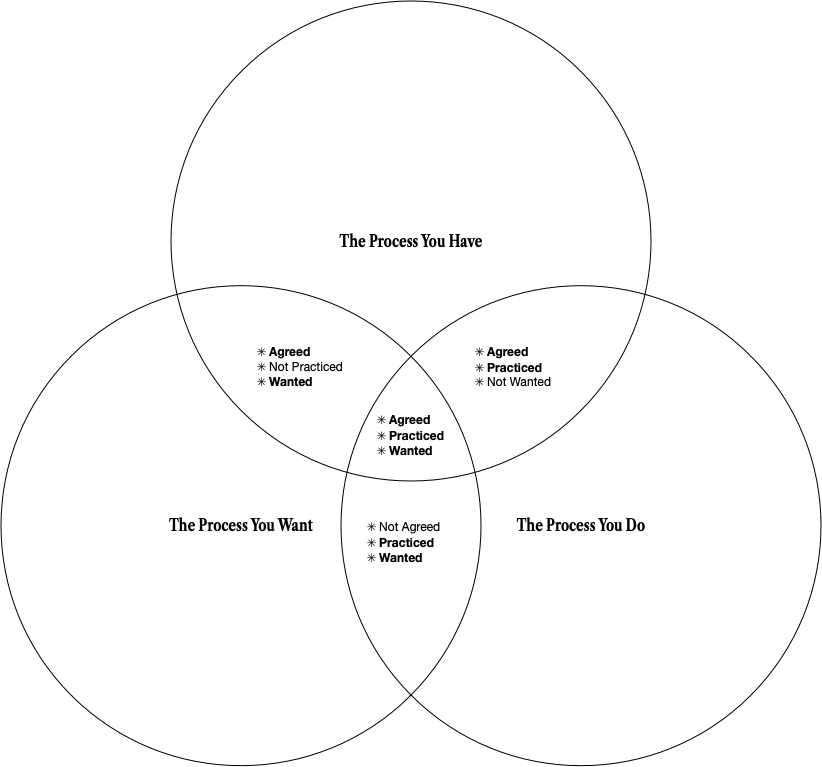
A Venn Diagram showing three overlapping circles: The process you have, the process you want and the process you do. The area overlapping "The process you have" and "The process you want" says "Agreed, not Practiced, wanted". The area overlapping "The process you have" and "The process you do" says "Agreed, practiced, not wanted". The area overlapping "The process you want" and "The process you do" says "Not agreed, practiced, wanted" The area where all circles overlap says: "Agreed, practice, wanted"
It's important to keep an eye on these three processes, as they may be symptomatic of different issues.
# Prompts for Analysis
Here's some questions, and example statements to help you analyze and discuss your internal processes.
**Agreed, Practiced, but Not Wanted**
* What problem were we trying to solve by agreeing to this? * Have the circumstances changed? * Was the original problem not the root of the problem? * Is the friction introduced worth the value we get? * What would happen if we stop doing this? * Is this preventing us from doing something else?
**Agreed, Not Practiced, but Wanted** * What's preventing us from actually doing this? * What can we change for us to do this? * Was the original problem real or worth solving? * Is the friction introduced worth the value we get? * Are there other aspects of our way of working that conflict with this?
**Not Agreed, Practiced, Wanted**
* Is there benefit to explicitly encoding this?
* Have we created a desire path  ?
* Is there a problem we haven't acknowledged?
* Are there encoded practices this can replace?
?
* Is there a problem we haven't acknowledged?
* Are there encoded practices this can replace?
# What is Good Process?
Good process should aim to bring those three circles as close together as possible: it should be imperceptible thanks to reduced friction, it should be explicit so it can be measured, audited and optimized, and it should reflect reality.
However, a good process isn't something objective or permanent. As circumstances change, a good process might become a bad process if left unattended.
A bad process almost never becomes a good one.